Perfect Binding: How Many Pages Do You Need, and When Is It the Right Choice?
Who this is for: you've written a book, compiled course notes, or put together a manual, and now you're deciding how it should be bound. Someone told you "perfect binding" is the professional choice, but nobody told you whether your page count actually suits it. This guide answers that directly, with the rule we use at Bookberry.
Short answer first
Perfect binding, also called glue binding, suits books above 60-70 pages. That's the rule we follow at Bookberry: if your book is thicker than 60-70 pages, perfect binding gives you a clean, professional paperback with a proper spine. If it's thinner than that, you're better off with saddle stitch (stapled) binding or tape binding.
The rest of this guide explains why that number matters, what happens if you ignore it, and how to decide for your own book.
What perfect binding actually is
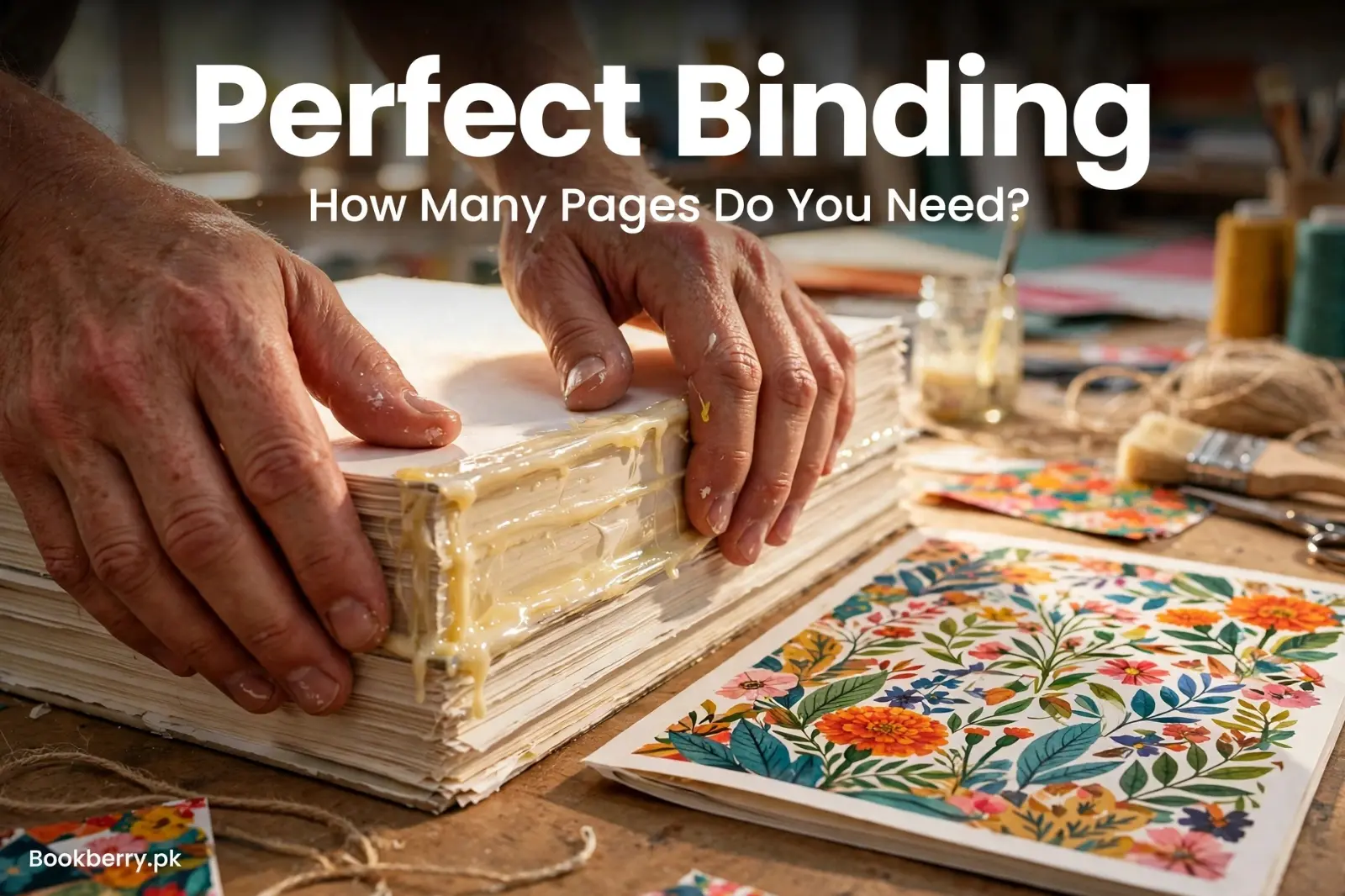
Perfect binding is the binding you see on most paperbacks. The inside pages are stacked, the spine edge is roughened and coated with strong glue, and a soft cover is wrapped around the whole block. When it dries, you get a flat spine you can print a title on, the kind of book that looks right on a shelf.
It is the standard choice for novels, poetry collections, course books, manuals, corporate reports and catalogues. If you walk into any bookshop in Karachi, most of what you pick up is perfect bound.
Why 60-70 pages is the minimum
A perfect-bound spine needs something to hold on to. The glue grips the edge of the page block, and if that block is too thin, there simply isn't enough surface for a lasting bond.
Here's what goes wrong below 60-70 pages:
- Pages can loosen over time. A thin spine means a thin line of glue. Open and close the book a few dozen times and pages start to work free, usually from the middle.
- The spine looks wrong. A 30-page book has a spine only a few millimetres wide. There is no room for a title, and the cover wraps so tightly that the book never quite sits flat.
- The book feels flimsy. A paperback earns its professional feel from a solid spine. Without one, it feels like a stapled booklet wearing a cover it doesn't need.
None of this means a thin book can't be bound well. It just means perfect binding is the wrong tool for it. At Bookberry we tell customers this before they order, because a binding that fails after two months costs everyone more than choosing the right one on day one.
What to use instead, below 60-70 pages
- Saddle stitch (stapled) binding: folded sheets stapled through the middle. Best for thin booklets, magazines, event programmes and short guides, usually up to around 48-64 pages, depending on paper thickness.
- Tape binding: the spine is taped rather than glued. A neat, durable option for slim reports, theses and office documents.
- Spiral or wire-o binding: the pages are punched and held by a coil, so the book lies completely flat. Best for workbooks, manuals and notes that someone writes in every day. For a fuller comparison of lay-flat options, see our guide on spiral binding for workbooks.
The right question isn't "which binding is best?" It is "which binding fits this book?"
Does paper thickness change the number?
Yes, and this is the detail most people miss. Page count alone doesn't set the spine thickness. Paper does too.
- A 60-page book on thick 100 GSM paper has a noticeably thicker spine than the same 60 pages on light 70 GSM paper.
- Art paper and heavy stock bulk up fast, so a shorter book can still bind well.
- Very light paper makes a thin spine even thinner.
So treat 60-70 pages as a practical rule, not a law of physics. If your book is near the line, say 55 pages on heavy paper, message us on WhatsApp with the page count and paper, and we'll tell you honestly whether perfect binding will hold or whether another binding is safer. For more on choosing paper, read our guide to book printing costs and options in Pakistan.
When perfect binding is the right choice
Choose perfect binding when:
- Your book is above 60-70 pages.
- You want a printed spine with the title and author name.
- The book will be sold in shops or gifted, it looks like a "real" book.
- The content is stable and won't be revised every month.
Picture this: Ayesha, a teacher in North Nazimabad, has 120 pages of English notes she refined over three years. She wants one bound copy per student for the new term. Perfect binding is exactly right. The books stack neatly, the spine carries the subject name, and they survive a school bag.
Choose something else when:
- The book must lie flat while someone writes in it, spiral binding wins there.
- It's under 60 pages, saddle stitch or tape binding will look and last better.
- The content changes constantly, a thinner, cheaper binding makes reprints less painful.
How to prepare your file for perfect binding
A little preparation here saves a failed print run.
Finish the inside pages first
Your spine width depends on your final page count and your paper. So finalise the inside pages before you finalise the cover. If you add or remove pages later, the spine changes and the cover has to be redone.
Send the cover as a separate file
A perfect-bound cover is one wide piece: back cover, spine and front cover. Send it as a separate file (we accept PDF, PSD and Illustrator AI), or as the first page of your PDF. If you designed the cover before knowing the page count, tell us. Our team can help adjust it.
Mind the gutter
Keep comfortable margins on every side, with a little extra on the inside edge near the spine. Text that runs too close to the binding edge disappears into the glue. For a full checklist, see our guide on PDF book printing in Karachi for schools and teachers.
Check your page count is even
Perfect-bound books are built from folded sheets, so the total page count should be an even number. If yours is odd, add a blank page at the end, usually after the last chapter or before the back cover.
What affects the cost of perfect binding?
As with all book printing, the price of a perfect-bound book moves with page count, paper type and weight, colour or black-and-white interior, quantity and cover finish. We deliberately don't quote fixed rupee figures here, because paper prices change often and every job is different. The practical way to compare is to ask for a quote at two or three quantities, say 50, 100 and 300 copies, and compare the totals. Digital printing usually suits smaller runs; for large runs of identical copies, ask for an offset quote too. Our guide on digital vs offset printing explains the trade-off in detail.
How long does perfect binding take?
At Bookberry, printing takes 3-5 working days in Karachi and 5-7 working days for other cities. Binding is part of that time, not extra. If you have a launch date or a term start in mind, tell us when you order so we can plan around it, and send final files early, because last-minute content changes are what usually blow deadlines.
There's no minimum order at Bookberry. You can print a single copy, and we take bulk orders too.
Frequently asked questions
What is the minimum number of pages for perfect binding?
As a practical rule, above 60-70 pages. Below that, the spine is too thin for the glue to hold well, and saddle stitch or tape binding is a better choice.
Can I perfect bind a 40-page book?
You can, but we wouldn't recommend it. The binding will look thin and may not last. For a 40-page book, saddle stitch usually looks smarter and holds better, and it costs less.
Does perfect binding lie flat?
No, and that's normal for a paperback. If you need the book to lie flat while someone writes in it, spiral or wire-o binding is the right choice instead.
Is perfect binding the same as paperback binding?
Nearly. Perfect binding is the method used to make most paperbacks: pages glued into a soft cover. When people say "paperback binding", this is usually what they mean.
How long does a perfect-bound book last?
With a proper spine thickness and normal use, years. The books that fail early are almost always the ones bound below the minimum page count, or stored in damp conditions.
Can I perfect bind a 50-page book?
You can, but we wouldn't recommend it. At 50 pages the spine is very thin and the glue can't grip firmly. For a book like that, saddle stitch or tape binding stays stronger and looks better. Send your page count and paper details on WhatsApp and we'll honestly tell you which binding will work best.
Ready to bind your book?
If your book is above 60-70 pages and you want that clean paperback look, perfect binding is probably your answer. If you're below the line, we'll tell you so, and recommend the binding that actually fits.
Message us on WhatsApp at +92 334 4426657 with your page count, size, paper and quantity, or email [email protected]. Our office is at Office # 53/54, 4th Floor, Idrees Chamber, I.I Chundrigar Rd, opp. NBP Head Office, Lalazar, Karachi (Mon-Sat, 11:00am-8:00pm). You can also read our guide on how to publish a book in Pakistan if your manuscript is on its way to becoming a book.

Comments (0)