AI Wrote Your Book in a Week. Printing It Still Takes a Real Printer
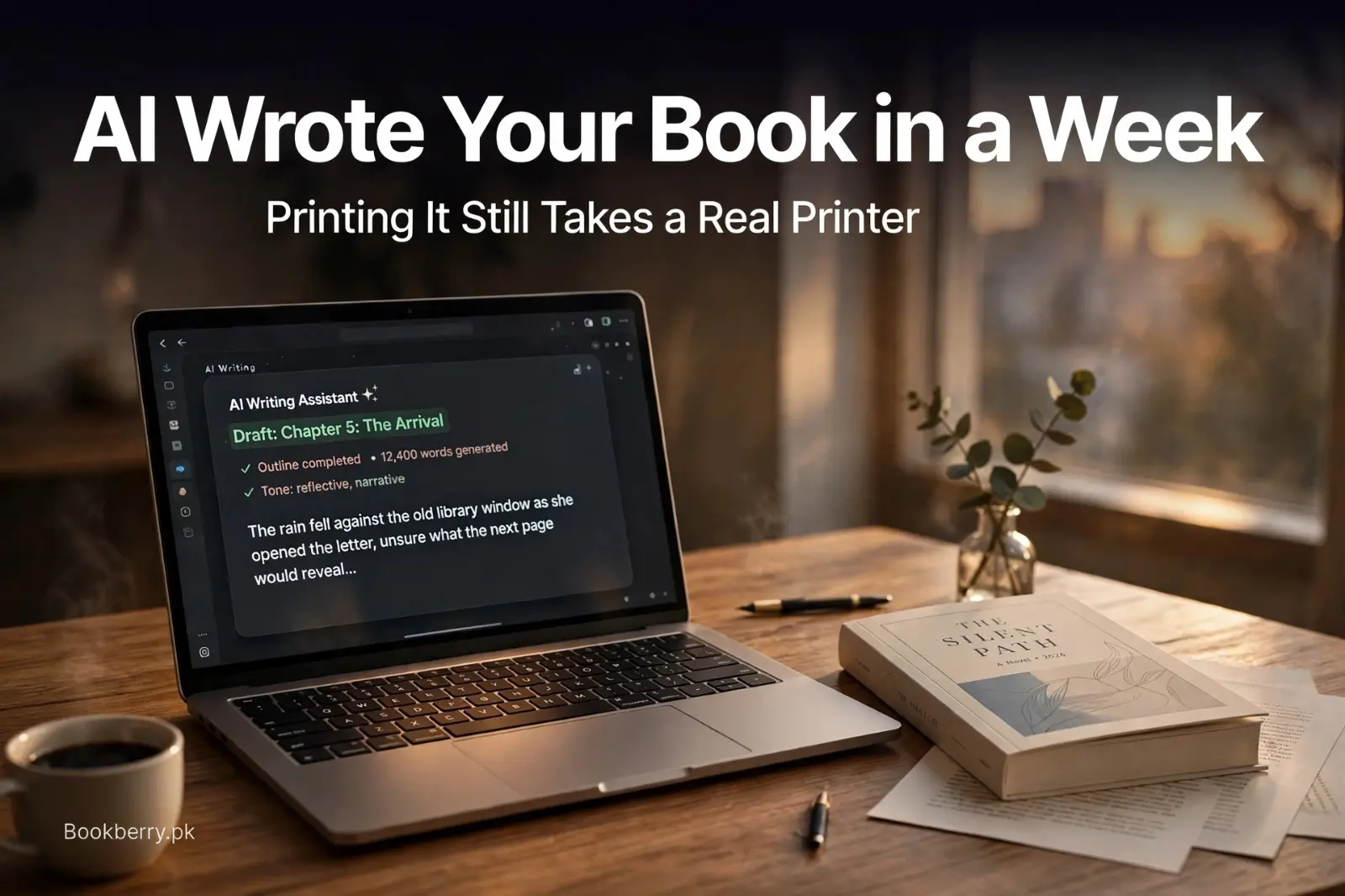
Who this is for: you used an AI tool to draft your book fast, maybe in a week, and now you want to hold it as a real printed book. This guide explains what AI does well, where it quietly fails, and what still has to happen before your book is ready for print.
Short answer first
AI can draft a book fast, but it cannot finish one. It repeats itself, gets facts wrong, and writes in a voice that sounds like everyone else. A printed book makes every one of those problems permanent, because you cannot edit ink. Before you print, a human still has to edit, fact-check, format, and proofread. The printing itself has not changed at all. File check, proof copy, print, bind. AI changed how fast you can draft. It changed nothing about how a good book is made.
What AI is genuinely good at
Give AI its due. It is a strong drafting tool.
- Beating the blank page. Staring at an empty document is the hardest part of writing. AI can give you a first draft, an outline, or a chapter structure in minutes.
- Speed. A first draft that might take three months by hand can exist in a week. For authors with a clear idea and little time, that matters.
- Simple, clear language. AI writes clean, readable sentences. For a guide, a manual, or a simple story, that is often enough for a first pass.
If you used AI to get your book started, you used it well. The problem begins when authors treat that first draft as a finished book.
Where AI quietly fails
It repeats itself
Read an AI draft from start to finish and you will notice it. The same point appears in chapter 2 and chapter 7, in slightly different words. The same phrases return again and again. On a screen, you skim past it. In a printed book, your reader notices it by page 30, and trust starts to fade.
It gets facts wrong, confidently
AI does not know things. It predicts words that sound right. Dates, names, places, and figures in an AI draft can be wrong while reading perfectly smoothly. A history book with a wrong date, or a health guide with a wrong figure, is worse than no book at all. Every fact in your draft needs a human check against a real source.
It has no voice of its own
AI writes like everyone and no one. Your readers do not only buy information. They buy you, your stories, your way of seeing things. An AI draft has no childhood memory, no joke only you would make, no opinion it actually believes. If your book reads like it could have been written by anyone, readers will treat it that way.
It can copy without telling you
AI tools are trained on vast amounts of text, and they can produce passages close to existing work. You may not know it happened. Before printing, read your draft as if someone else wrote it, and check anything that sounds familiar. The words in your book should be yours, and you should be able to stand behind every page.
What still has to happen before printing
AI did the fast part. These are the slow parts, and skipping them is how bad books get printed.
- Edit like a human
Read the whole draft aloud, or have a friend read it. Cut the repeated points. Fix the flat sentences. Add your own stories, the ones only you can tell. This is where your book stops sounding like a machine and starts sounding like you. - Check every fact
Names, dates, places, numbers, quotes. Check each one against a real source. If you cannot verify something, remove it or mark it clearly as your opinion. A printed mistake cannot be edited later. - Format it as a book, not a document
A book needs proper page size, margins, page numbers, chapter headings, and a table of contents. A Word file with default settings is not a book file. Export a clean PDF with the page size you want, usually A5 for a novel or a general book in Pakistan. - Design a real cover
AI can suggest a cover idea, but a cover that sells a book needs a human eye. The title must be readable at a glance, the colours must suit the subject, and the spine must carry the title. If you designed the cover before knowing the page count, tell us, because the spine width depends on the final page count and paper. - Print a proof copy
This step matters more for an AI draft than for any other book. Read the proof copy in your hands, cover to cover. You will find mistakes you missed on screen, because print makes you read differently. Fix them, print a fresh proof if needed, and only then approve the full run.
Then the printing works exactly as before
Once your file is truly ready, printing an AI-drafted book is the same as printing any book. Send the PDF, choose size, paper, and binding, check the proof copy, and print as few or as many copies as you need. There is no minimum order at Bookberry. Printing takes 3-5 working days in Karachi and 5-7 working days for other cities.
A story from our shop
Picture this: a young writer in Lahore drafted a self-help book with an AI tool in six days. He was proud of the speed, and he sent it to us the same week. We printed a proof copy. He read it, and by page 20 he found the same advice repeated three times, a wrong date in chapter 4, and a story that did not sound like him at all. He took two weeks to rewrite those parts in his own voice, fixed the date, and cut 15 pages of repetition. Then he printed 100 copies and sold them at a small launch. The book that reached his readers was not the AI draft. It was his book, with AI as the starting point.
That is the right way to use AI. It starts the work. You finish it.
Frequently asked questions
Can I print a book I wrote with AI?
Yes. There is no rule against printing an AI-drafted book, as long as the words are yours to publish and you have checked them. The printing process is the same as for any book.
Will readers know my book was written with AI?
They may notice, if the text repeats itself, sounds flat, or gets facts wrong. A careful human edit removes most of the signs. Your own stories and voice remove the rest.
Should I tell readers I used AI?
That is your choice. Many authors now mention it openly. What matters most is that the book is accurate, original, and worth reading.
How do I check an AI draft before printing?
Read it fully, aloud if you can. Check every fact against a real source. Cut repetition. Add your own stories. Then print one proof copy and read it again in print before approving the full run.
Can a book written by AI be printed?
Yes, it can. But first, a person should read the whole book, fix the mistakes, and check the facts. Then print a proof copy and check it, and only after that print the full quantity.
Ready to print your book?
If your draft is edited, checked, and ready, send the PDF on WhatsApp at +92 334 4426657 with your page count, size, and quantity, or email [email protected]. Our office is at Office # 53/54, 4th Floor, Idrees Chamber, I.I Chundrigar Rd, opp. NBP Head Office, Lalazar, Karachi (Mon-Sat, 11:00am-8:00pm). If your draft still needs work, take the time. A book printed well is worth the extra two weeks.

Comments (0)